

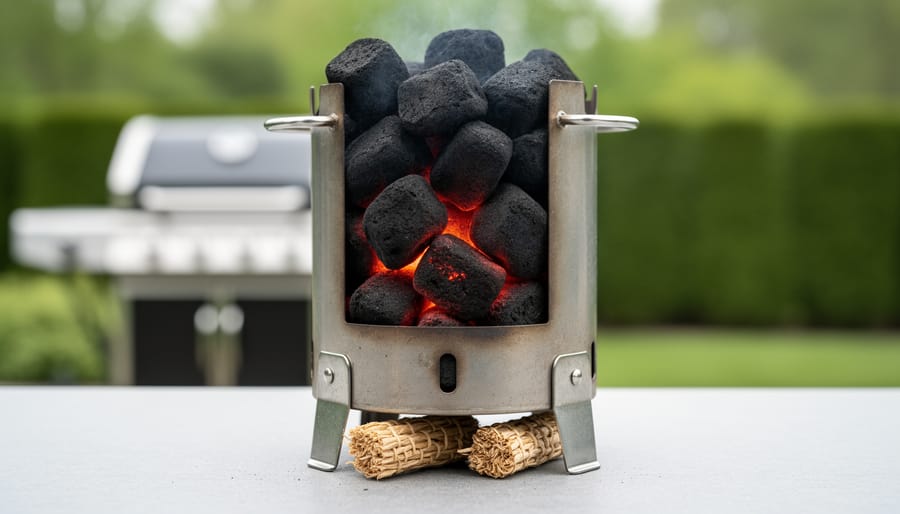
Yes, you can use lump charcoal in a chimney starter, and it works beautifully. Fill the canister, tuck a couple of fire starters underneath, and in about 15 to 20 minutes you’ll have glowing coals ready to dump into your grill. It’s an easy, beginner-friendly job that takes no special skills, just a few basic tools and a little patience.
Lump charcoal is simply hardwood that’s been burned down to nearly pure carbon, so it ignites quickly and burns hot. The pieces come in uneven sizes, which means you’ll want to load the canister a little differently than you would with uniform briquettes. We’ll cover that below.
A quick word on the fireplace question, since plenty of folks land here after asking it. Charcoal belongs outside. It gives off carbon monoxide as it burns, and a fireplace flue isn’t built to pull that gas safely out of your home. Think of it like running a table saw in a closed room with no dust collection: the tool is fine, the setting is the problem.
Below, you’ll find the tools you need, the safety basics, a step-by-step lighting routine, and a few simple cues that tell you the coals are ready.
Lump Charcoal vs. Your Fireplace: Why the Two Don’t Mix
So, can you use charcoal in a fireplace? In most cases, no, and the reasons are worth knowing.
First, a quick definition. Lump charcoal is hardwood that’s been charred in a low-oxygen kiln until only the carbon remains. You get irregular chunks that look like blackened bits of branch. Briquettes are the uniform pillows you see in big bags at the store, made from compressed charcoal dust, binders, and sometimes fillers.
Both burn far hotter than seasoned firewood. A fireplace and its grate are built for the gentler heat of split logs. Charcoal can run hot enough to warp a cast-iron or steel grate and stress the firebox bricks and mortar over time. That’s an expensive repair nobody wants.
The bigger problem is air. Charcoal gives off carbon monoxide, an odorless gas you can’t see or smell. A fireplace flue is designed to pull wood smoke up and out, but charcoal’s slow, smoldering burn can leave dangerous levels of gas drifting back into your living space. That’s why the answer to the fireplace question is generally no. If you want to learn how to use a fireplace safely, stick with seasoned firewood and keep the charcoal out.
A chimney starter is a different animal. It’s a grilling tool, a metal cylinder you fill with charcoal and light outdoors to get coals going for your grill. It isn’t a fireplace accessory, and it never belongs indoors. Keep that distinction in mind, and the rest of this guide will make a lot more sense.
Why Lump Charcoal Works Well in a Chimney Starter
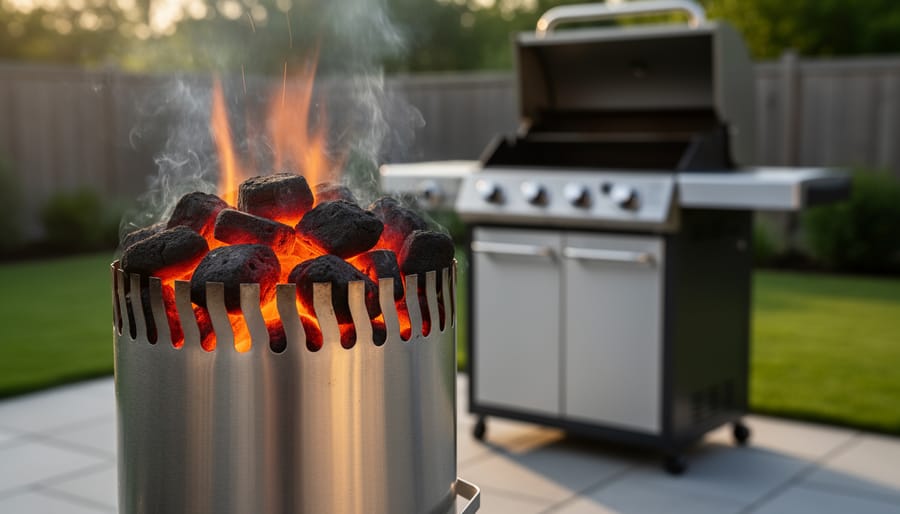
A chimney starter is simple, but it’s clever. It’s just a metal cylinder with a grate near the bottom and vent holes along the base. When you light your fire starters underneath, hot air rises straight up through the stacked charcoal, and cool air gets pulled in from below to feed the flames. That constant upward draft is what ignites the coals evenly, no lighter fluid required.
Lump charcoal is a great match for this setup. Because it’s charred hardwood in chunks, it has lots of surface area and gaps between the pieces, so air flows through easily and the whole pile catches fast. It also burns hot and leaves behind far less ash than briquettes, which means less mess to clean up and less fine ash clogging your vents.
Here’s a quick rundown of what to expect:
- It lights quickly, often noticeably faster than briquettes.
- It burns very hot, which is great for searing.
- It produces much less ash, so cleanup is easier.
- Pieces come in all different sizes, so you may need to break up the big ones.
- It burns out faster than briquettes, so plan to add more fuel for long cooks.
Those last two points are the honest tradeoffs. Irregular chunks can leave gaps or pack unevenly, so give the starter a gentle shake after filling it. And because lump burns faster, it’s a little less forgiving for low-and-slow cooking. None of this is a dealbreaker. It just helps to know what you’re working with before you light up.
Tools and Materials You’ll Need
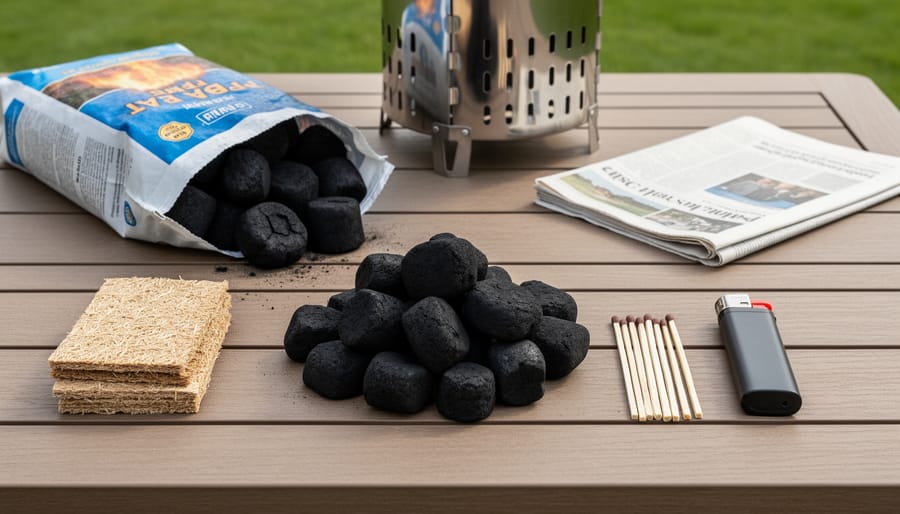
Before you light anything, gather your gear so you’re not hunting for a lighter while the coals are already going. Here’s your checklist:
- Chimney starter: The metal cylinder that does the heavy lifting by funneling air up through the coals.
- Lump charcoal: Enough to fill the top chamber, about a full load for a standard grill.
- Lighter cubes or newspaper: Your fuel for the flame; two cubes or a few loosely crumpled sheets will do.
- Long lighter or matches: Keeps your hands well away from the heat.
- Heat-resistant gloves: A loaded starter gets seriously hot, handle included.
- Fire-safe surface: Bare dirt, concrete, or a bricked pad, never wood or grass.
- A grill with a clear grate: Empty it of old ash so air flows freely.
If you like building your own gear, a small heat-safe staging stand or a fire-safe zone near your workspace is a great weekend project. Our list of essential shop tools covers what you’ll need to build one.
Safety Warnings Before You Light Up
Before you strike a match, take a minute for the safety basics. They’re simple, but skipping them is how most backyard mishaps happen.
Light your chimney starter only outdoors, in a well-ventilated spot with plenty of open air around it. That means never in a garage, shed, or workshop, even with the door cracked open. If you want a refresher on how to keep your workshop safe a good rule is that fire and sawdust never share a room.
A few more habits will keep you safe:
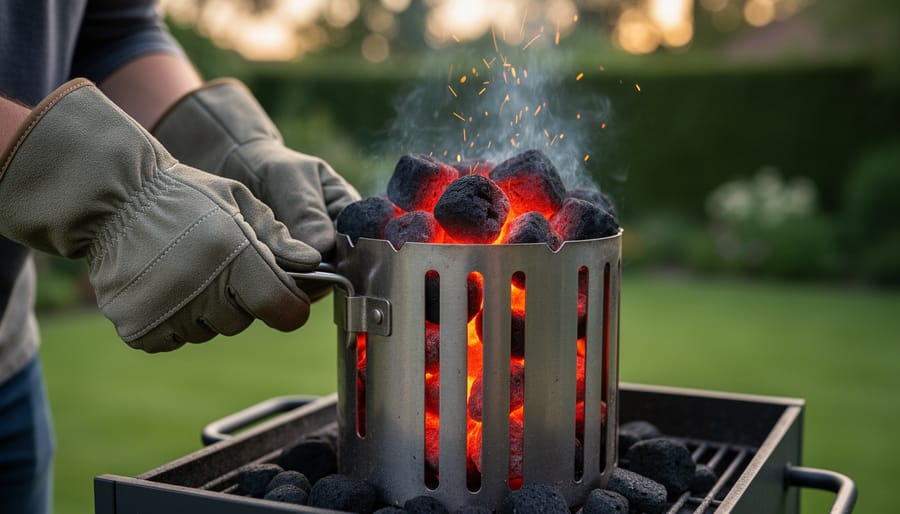
– Wear heat-proof gloves whenever you handle the starter, since the metal handle and body get very hot.
– Never use lighter fluid inside the chimney starter. Stick with lighter cubes or newspaper.
– Keep a fire extinguisher or a bucket of water within reach.
Know when to call it off, too. Skip lighting if the wind is gusty, if the starter’s handle is loose or damaged, or if your outdoor space is stacked with lumber and other wood-heavy projects nearby. Waiting for a better day always beats taking a chance.
Step-by-Step: Lighting Lump Charcoal in a Chimney Starter
Lighting lump charcoal in a chimney starter is easy once you’ve done it a couple of times. Plan on about 15 to 20 minutes from lighting to pouring, depending on the weather and how much charcoal you load. Here’s the full process:
- Set your grill outdoors on a flat, stable spot and put the chimney starter on a non-flammable surface like bare concrete, pavers, or the grill’s bottom grate. Keep it well away from sawdust, wood scraps, and your deck.
- Place one or two lighter cubes (or two loosely crumpled sheets of newspaper) in the bottom of the grill, directly under the chimney’s base. If your starter has a base plate with air holes, the cubes go beneath it.
- Fill the top chamber with lump charcoal. Snap or tap any oversized chunks into pieces roughly the size of a fist or smaller so they fit and burn evenly.
- Light the starters through the vent holes at the bottom, using a long lighter or match, and step back. Flames will start climbing through the charcoal within a few minutes.
- Wait about 10 to 15 minutes, until flames lick out of the top and the upper pieces are covered in light gray ash.
- Put on your heat-resistant gloves, grip the handle firmly, and pour the glowing coals onto the grill grate in one smooth motion.
- Set the empty chimney down on a heat-safe surface and let it cool on its own.
One tip makes a real difference: don’t pack the charcoal down tightly. Lump charcoal comes in odd shapes, and the gaps between pieces are what let air flow up through the cylinder like a little chimney should. If you stuff it full of tiny bits and dust, airflow gets choked and lighting slows way down. A mix of medium and large chunks with a few small pieces tucked between them works best.
If the top layer hasn’t started to ash over after 15 minutes, don’t panic. Give the chimney a light shake to settle the pieces and check that nothing is blocking the bottom vents. A little patience usually solves it.
How to Tell It’s Ready and What to Do Next
Your coals are ready when the top layer is coated in gray ash and you can see an orange-red glow deeper down. That usually takes 15 to 20 minutes. If the flames at the top have died back and you’re only seeing a light haze, you’re good to pour.
For direct heat, spread the coals in an even layer across the whole grate. For indirect heat, bank them on one side and leave the other side empty, so you can cook food away from the fire. Once the grill is set up, close the lid until the temperature settles.
When you’re done, close the vents and lid to starve the fire of air, and let everything cool for at least 24 hours. Then scoop out the cold ash into a metal container, and store charcoal safely in a dry, sealed bin away from sawdust and finishes.
If lighting is slow, you’ve probably packed the pieces too tightly or the starter is sitting on a surface that blocks airflow from below. Uneven burning usually means mixed piece sizes, so break up the big chunks next time.
Can I reuse leftover lump charcoal?
Yes. Once the pieces are fully cooled, pick out the unburned chunks and use them to start your next fire.
Why is my lump charcoal burning out fast?
Lump burns hotter and faster than briquettes, especially with the vents wide open. Closing the vents partway slows the burn down.
Can I mix lump and briquettes?
You can. Lump lights quickly and briquettes help the fire last longer.
Is it ever okay to burn charcoal in a fireplace?
No. Charcoal produces carbon monoxide that can build up indoors, and it burns hotter than a fireplace is built to handle.
Once the grill is hot, you’re ready to cook.
So, can you use lump charcoal in a chimney starter? Absolutely. It lights quickly, burns hot, and leaves less ash behind, as long as you’re outdoors on a fire-safe surface with the right gear on hand. Keep your charcoal in the grill setup where it belongs, and leave your indoor fireplace for seasoned firewood only.
Before you light up, give yourself a quick safety check: gloves on, flammables well out of reach, and water or an extinguisher nearby. Those few seconds of prep make every cookout calmer and a lot more fun.
If grilling has you itching for a new project, you’re in good company. Plenty of folks get hooked on building a heat-safe outdoor prep station or finally taming a messy workshop with custom storage. Our step-by-step tutorials and woodworking courses walk you through each cut and joint, no advanced skills required. Grab your tools and enjoy the process!
