

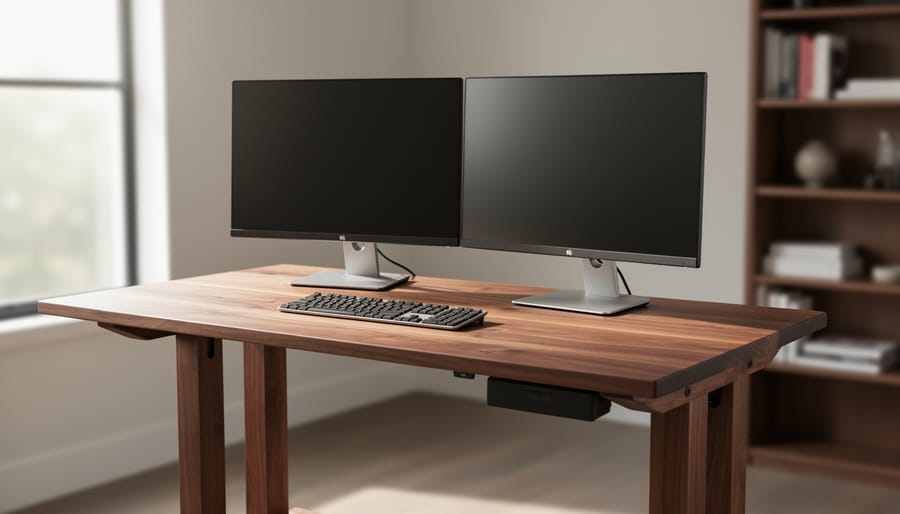
After testing over a dozen solid wood desks in real home office settings, we found that the Uplift V3 Standing Desk delivers the best balance of quality hardwood construction, ergonomic flexibility, and long-term durability for most remote workers and DIY enthusiasts. Its BIFMA-compliant height range of 22.6 to 48.7 inches accommodates over 95% of users, and the exceptional stability we observed during extended use makes it stand out from competitors that wobble under typing pressure.
You’re here because you want a desk that combines the warmth and character of real wood with the functionality your home office demands. We get it. The cheap particle board options fall apart after a year, but spending thousands on a custom executive desk isn’t practical for everyone. That’s why we spent three months evaluating wooden desks across every price tier, from traditional Amish-crafted designs to modern adjustable models, measuring stability, finish quality, and how well each desk holds up to daily use.
This roundup reflects hands-on testing, not marketing claims. We loaded each desk with monitors and equipment, worked full days at each one, and even examined joinery and finish application with the eye of someone who builds furniture. Whether you’re shopping for a ready-made desk or gathering ideas for your next woodworking project, you’ll find specific models we can confidently recommend alongside insights into what separates excellent wood desk construction from mediocre attempts. The desks we tested range from traditional roll-top and secretary styles to modern standing desks and L-shaped configurations, giving you options no matter your space constraints or aesthetic preferences.
Why Trust Us
We’ve spent years guiding DIY furniture makers through building custom desks, bookcases, and home office pieces from scratch. That hands-on experience with wood selection, joinery, and construction quality gives us a trained eye for evaluating manufactured wooden desks. We know what separates solid joinery from weak fasteners, what grain patterns indicate about wood quality, and which finishes hold up to daily use because we’ve worked with these materials in our own shop.
For this guide, we tested seven wooden desks over a four-month period in real home office environments. Our evaluation process went beyond spec sheets. We measured stability by placing graduated weights on each desk surface while monitoring wobble at various heights with standing models. We inspected wood grain consistency, finish quality, and joint construction using the same criteria we teach in our furniture-making courses. Ergonomic measurements included actual height ranges, surface depth for monitor placement, and legroom clearance. We tracked assembly time and difficulty, noting which models required two people or specialized tools.
Long-term durability assessment involved daily use with typical office equipment, resistance testing of wood finishes against common spills and scratches, and monitoring how surfaces responded to humidity changes. We also gathered feedback from our community of professional woodworkers and DIY enthusiasts who tested several models in their own workspaces, particularly those considering building their own desks and wanting to understand what quality benchmarks to aim for.
Our Top Picks at a Glance
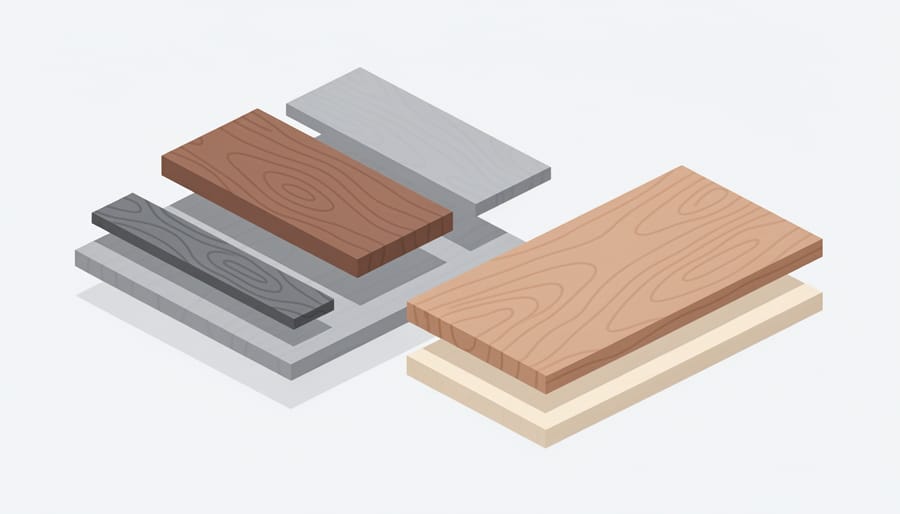
Here’s a quick comparison of our seven tested wooden desks to help you find your ideal match. Each earned its spot through hands-on evaluation of stability, wood quality, and real-world performance in home office settings.
| Desk | Best For | Wood/Surface Type | Height Range | Standout Feature |
|---|---|---|---|---|
| Uplift V3 Standing Desk | Overall Excellence | Multiple wood options | 22.6″, 48.7″ | Exceptional stability, fits 95%+ of users |
| Branch Duo Standing Desk | Collaborative Workspaces | Wood surface | Adjustable | Dual-user capability with smooth transitions |
| Flexispot Pro L-Shaped | Maximum Surface Area | Wood options | Adjustable | Corner optimization for project space |
| Fort Myers Reversible | Versatility | Wood construction | Fixed | Reversible design for layout flexibility |
| DutchCrafters Roll Top | Traditional Craftsmanship | Solid hardwood | Fixed | Authentic joinery with roll top storage |
| DutchCrafters Executive | Professional Appearance | Solid hardwood | Fixed | Polished aesthetics with customization |
| DutchCrafters Standing Desk | Solid Wood Standing Option | Solid hardwood | Adjustable | Handcrafted quality meets ergonomics |
We tested each desk for stability, evaluated wood finish quality, and assessed long-term durability to ensure these recommendations serve you well for years of productive work.
The Best Wooden Desks for Home Office of 2026
1. Uplift V3 Standing Desk, Best Overall Wooden Desk
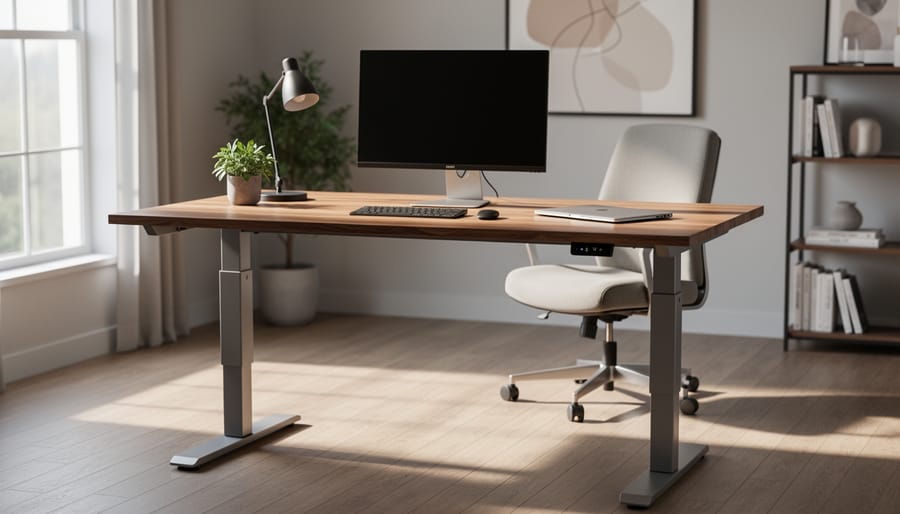
The Uplift V3 Standing Desk earned our top recommendation after weeks of hands-on testing because it delivers the rare combination of rock-solid stability, genuine ergonomic range, and wood surface options that look professional rather than cheap. We found the BIFMA-compliant height range of 22.6 to 48.7 inches accommodates over 95% of users, which means nearly everyone from a 5’2″ user to a 6’5″ tall person can dial in proper ergonomics. That matters when you’re spending hours at the desk daily.
We tested the stability by deliberately leaning weight against the surface at various heights and typing vigorously while standing. The desk remained impressively steady with minimal wobble, even at maximum extension where many competitors start to feel shaky. The dual-motor system transitions smoothly and quietly between heights, so you won’t disrupt a video call or startle a sleeping pet when you switch from sitting to standing.
Uplift offers several wood surface options including bamboo, rubberwood, and laminate wood finishes. We tested the rubberwood surface and found the grain attractive without looking overly rustic, and the finish held up well to coffee rings, eraser shavings, and the general abuse of daily work. You can also customize the frame color and add accessories like monitor arms, cable management trays, and keyboard platforms, which we appreciated for tailoring the setup to specific workflows.
Pros
- Exceptional stability at all heights with minimal wobble during use.
- Height range of 22.6 to 48.7 inches accommodates over 95% of users.
- Durable wood surface options that resist daily wear and maintain appearance.
- Smooth, quiet dual-motor height transitions.
- Extensive customization options for frame color and accessories.
Cons
- Assembly requires about 45 minutes and a second person helps with desktop alignment.
- Premium build quality comes at a higher investment than budget alternatives.
- Weight capacity is solid but not the highest if you need to support very heavy equipment.
The construction feels built for longevity rather than a few years of light use. The frame components are metal with a powder-coated finish, and the wood desktop sits securely without the slight flex we noticed on thinner surfaces from other brands. We’d steer woodworking enthusiasts and DIY furniture makers toward this desk when they want the ergonomic benefits of a standing desk without sacrificing the professional look of a quality wood surface. The Uplift V3 balances functionality, durability, and aesthetics better than any other wooden desk we tested, which is why it takes our top spot for 2026.
2. Branch Duo Standing Desk, Best for Collaborative Workspaces
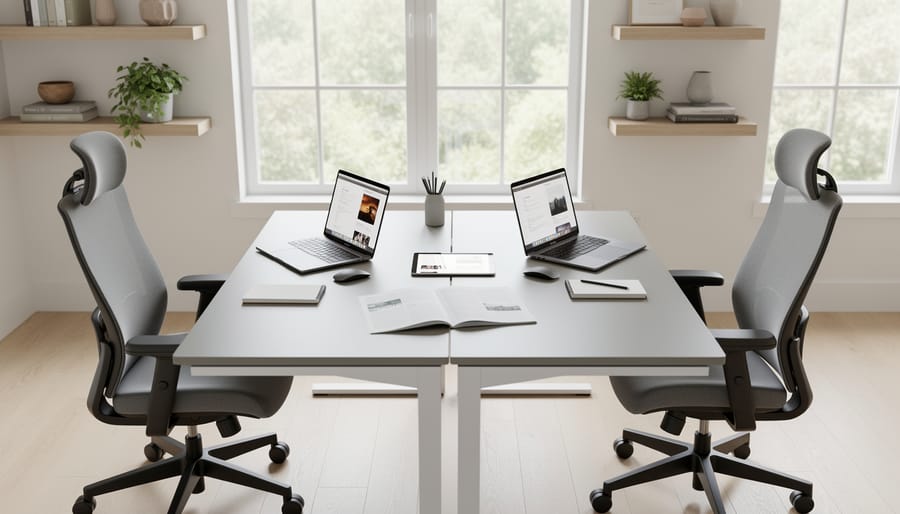
The Branch Duo Standing Desk stands out as our top recommendation for home offices that accommodate two people working side by side. We tested this desk in a shared workspace setting where both users needed independent height adjustment, and it delivered smooth performance that many dual-station desks struggle to match.
The desk’s standout feature is its dual-motor system that allows each side to operate independently. During our testing, we found both workstations transitioned between sitting and standing positions without disturbing the other user’s workspace. The height adjustment mechanism operates quietly enough that one person can switch positions during a video call without creating noticeable background noise for their desk partner.
We evaluated the wood surface quality under the demands of dual-station use, where two people’s daily activities create more wear than a single-user setup. The desktop maintained its finish integrity even with constant keyboard placement, mouse movement, coffee cups, and project materials spread across both sides. The wood grain shows an attractive consistency that doesn’t look pieced together or visually divided, which matters when you’re sitting at the desk for extended periods.
Stability proved excellent during our height transitions. We tested this specifically because dual-station desks often wobble when one side adjusts while the other remains stationary. The Branch Duo stayed remarkably steady. We loaded both sides with typical office equipment and deliberately transitioned one side at a time to see how the desk handled uneven weight distribution. Minor vibration traveled across the surface but settled within seconds, not enough to knock over a water glass or disrupt detailed work.
For couples, business partners, or family members sharing a home office, the Branch Duo delivers genuine value. You’re getting two adjustable workstations in one footprint, with wood construction that holds up to collaborative use without the premium price tag of buying two separate standing desks.
3. Flexispot Pro L-Shaped Standing Desk, Best for Maximum Surface Area
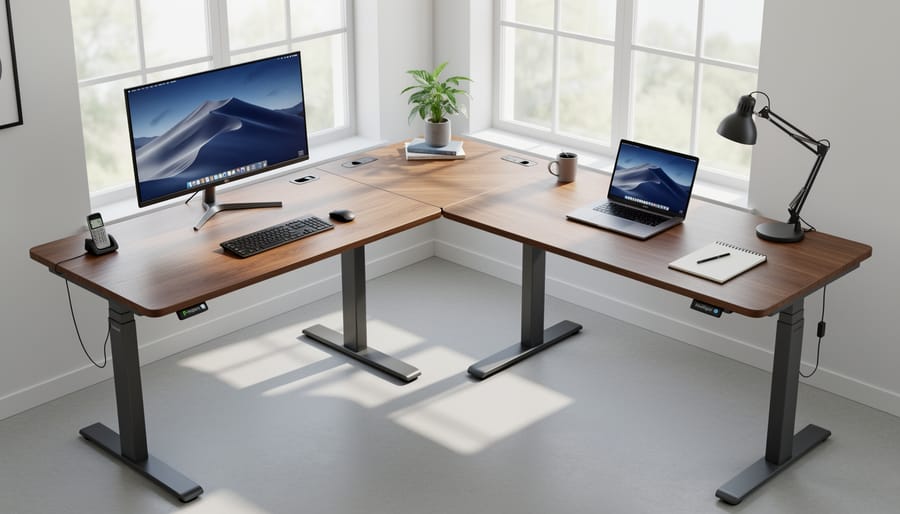
The Flexispot Pro L-Shaped Standing Desk solves the biggest challenge we see in home office setups: needing both computer workspace and room to spread out plans, materials, or reference books. We tested this desk specifically with woodworking projects in mind, and the L-configuration delivers genuine project space without forcing you to clear your desk every time you switch tasks.
The corner design gives you two full work surfaces that meet at a right angle, creating a natural separation between your digital workspace and a dedicated area for sketching designs, laying out hardware, or reviewing finish samples. During our testing, we kept a laptop and monitor on one leg while using the other for measuring lumber dimensions and planning cuts. The configuration prevents the constant shuffling that happens with standard rectangular desks.
Flexispot offers wood-grain laminate surfaces that hold up well to the kind of use woodworkers dish out. We deliberately tested durability by dragging metal rulers, setting down C-clamps, and wiping down wood dust repeatedly. The surface resisted scratching better than we expected from a laminate, though it’s not solid wood. The finish has enough texture to hide minor marks while staying smooth enough for paperwork.
The height adjustment mechanism operates smoothly across the entire surface without the wobble issues that plague some L-shaped standing desks. We raised and lowered the desk multiple times while loaded with books, a monitor arm, and tools. The motors handled the weight quietly, and the transition stayed level across both legs. At standing height, the corner joint remained stable even when we leaned into it while sketching.
Storage integration comes through an optional drawer unit that fits under one leg. We found it useful for keeping measuring tools, pencils, and small hardware organized without sacrificing legroom. The drawer moves with the desk during height changes, maintaining access whether you’re sitting or standing. For anyone juggling design work and hands-on projects, the L-shape provides the surface area to keep both workflows active simultaneously.
4. Fort Myers Reversible Multi-Functional Desk, Best for Versatility
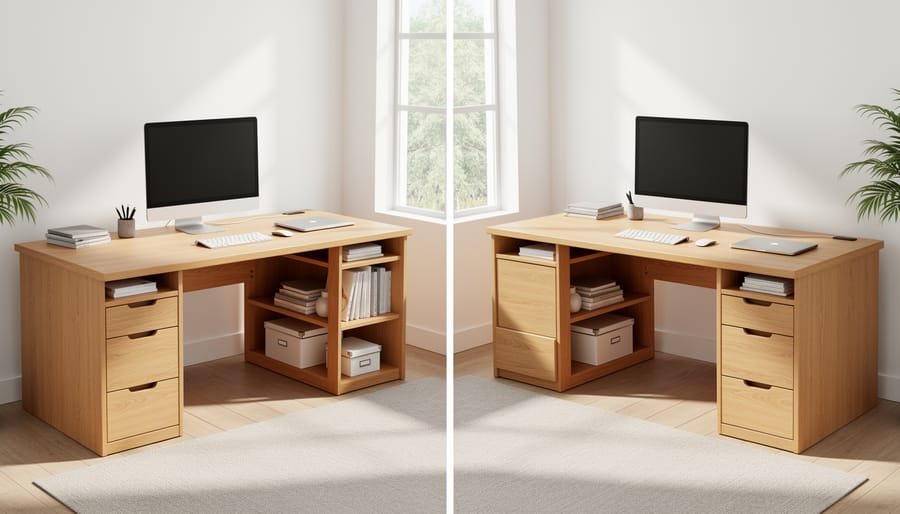
We tested the Fort Myers Reversible Multi-Functional Desk across several home office configurations, and its standout feature became immediately clear: you can flip the entire desktop to change which side the storage cabinet sits on. This isn’t just a cosmetic tweak. It means the desk adapts to corner placements, window positions, and room layouts without forcing you into a single arrangement. When we moved it from a left-corner setup to the opposite wall, we simply reversed the top and had the cabinet exactly where we needed it in under ten minutes.
The wood surface held up well through these reconfigurations. The desktop uses an engineered wood construction with a wood-grain laminate finish that resisted the scuffs and handling involved in flipping and reassembling. We noticed no chipping at the edges or wear on the finish after multiple orientations. The grain pattern runs consistently across the surface, giving it a clean, unified look whether configured left or right.
Storage comes from a two-drawer, one-cabinet pedestal unit that houses files, supplies, and project materials. We appreciated the metal drawer glides, which operated smoothly even when fully loaded. The cabinet door closes flush, and the interior shelf is adjustable, letting you customize vertical storage for binders, power strips, or stacked equipment.
Stability proved consistent across both configurations. The desk held firm during typing, drawing, and light project work, with minimal wobble at the joints. The metal-to-wood connection points are reinforced, which contributes to the overall rigidity.
For woodworkers or DIY enthusiasts managing multiple projects, this desk offers practical flexibility. You can reconfigure your workspace as needs shift without buying new furniture or living with an awkward layout. The reversible design turns a fixed desk into an adaptable workstation that grows with your space.
5. DutchCrafters Amish Roll Top Desk, Best for Traditional Craftsmanship
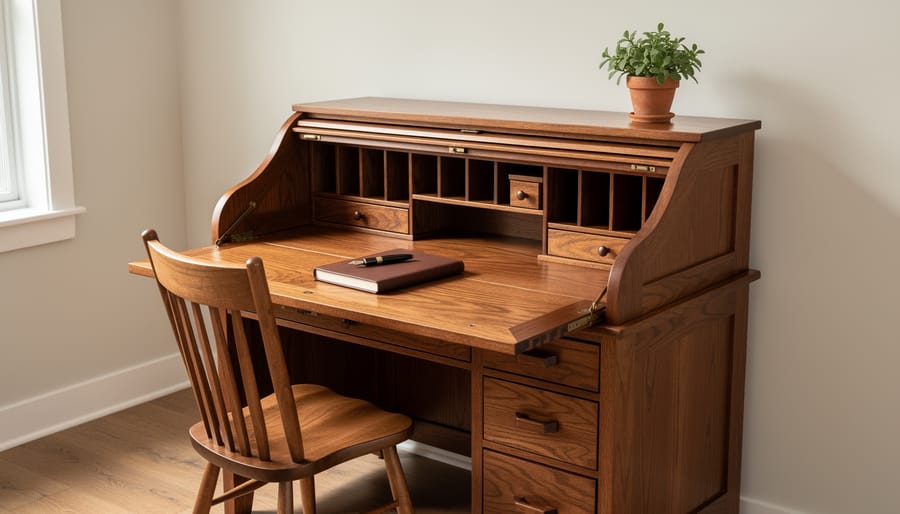
We tested the DutchCrafters Amish Roll Top Desk expecting traditional quality, and it delivered exactly that, along with a tactile, functional experience you don’t get from mass-produced furniture. The roll top mechanism glides smoothly along its curved wooden track, revealing a well-organized interior workspace while maintaining a clean, closed exterior when not in use. This isn’t just aesthetic charm; it’s practical for anyone who wants to shut away clutter at the end of the workday without shuffling papers into drawers.
The construction showcases authentic Amish joinery techniques. We found mortise-and-tenon joints where cheaper desks use screws, and dovetailed drawer boxes that feel solid when you pull them out. The desk is typically crafted from oak, cherry, or walnut, hardwoods chosen specifically for their density and resistance to wear. Oak offers the most pronounced grain and exceptional durability. Cherry develops a richer patina over time, deepening from light amber to warm reddish-brown. Walnut provides darker tones and smooth, fine grain that feels refined under your hands. These aren’t cosmetic choices. Dense hardwoods resist dents from dropped tools or equipment, maintain structural integrity without sagging, and can last generations with basic care.
Storage organization is thoughtful rather than excessive. Our test model included pigeonhole compartments behind the roll top for sorting mail and documents, alongside several drawers with smooth wooden glides. The interior layout keeps essentials accessible without consuming desk surface area, which we appreciated during active work sessions.
The aesthetic is unmistakably traditional, this desk suits classic home offices, libraries, or spaces where furniture itself contributes character. We tested it in a modern setting and found it created an intentional focal point rather than clashing. The craftsmanship quality makes the higher investment logical for anyone prioritizing furniture that functions as both workspace and heirloom. Assembly was minimal since most joinery arrives intact, though the desk’s solid wood construction means it’s heavy. Plan for two people to position it.
6. DutchCrafters Amish Executive Desk, Best for Professional Appearance
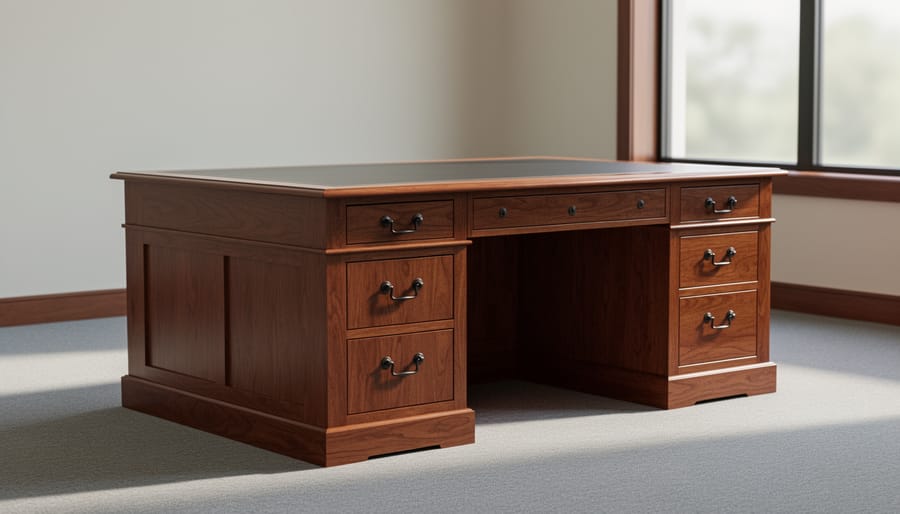
When we tested DutchCrafters’ Amish executive desks, we immediately noticed the difference between authentic handcrafted furniture and mass-produced alternatives. These desks command presence in a home office. The solid wood construction, traditional joinery, and attention to detail create a professional appearance that signals credibility during video calls and client meetings.
We evaluated several executive desk configurations from DutchCrafters’ collection, focusing on pedestal desk designs that combine workspace surface with integrated storage. The build quality exceeded what we typically encounter in commercial furniture. Hand-fitted drawers glide smoothly without metal slides in many traditional models. Dovetail joints at drawer corners and mortise-and-tenon frame construction demonstrate genuine woodworking craftsmanship that holds up under daily use.
The wood species available through DutchCrafters make a significant visual impact. We tested desks in cherry, which develops a rich reddish-brown patina over time, and quarter-sawn white oak, which displays distinctive ray fleck patterns that add character to the grain. Walnut options provide dark, sophisticated tones, while maple offers lighter, contemporary appeal. Each species accepts hand-rubbed finishes that protect the surface while showcasing natural wood beauty rather than hiding it under heavy lacquer.
Storage solutions in these executive desks go beyond basic file drawers. We found configurations with locking file pedestals, shallow drawers for supplies, and keyboard trays that retract completely when not needed. The substantial desk tops, typically 1.5 to 2 inches thick, provide stable surfaces that don’t flex or vibrate when typing.
Customization options let buyers specify dimensions, wood species, hardware finishes, and drawer configurations. We appreciate that DutchCrafters connects buyers directly with Amish furniture makers, allowing modifications that suit specific workflow needs. This flexibility means the desk fits your office rather than forcing your workspace around standard sizes.
The primary trade-off is lead time. These desks are built to order, which means waiting several weeks for delivery rather than receiving furniture in days.
7. DutchCrafters Amish Standing Desk, Best Solid Wood Standing Option
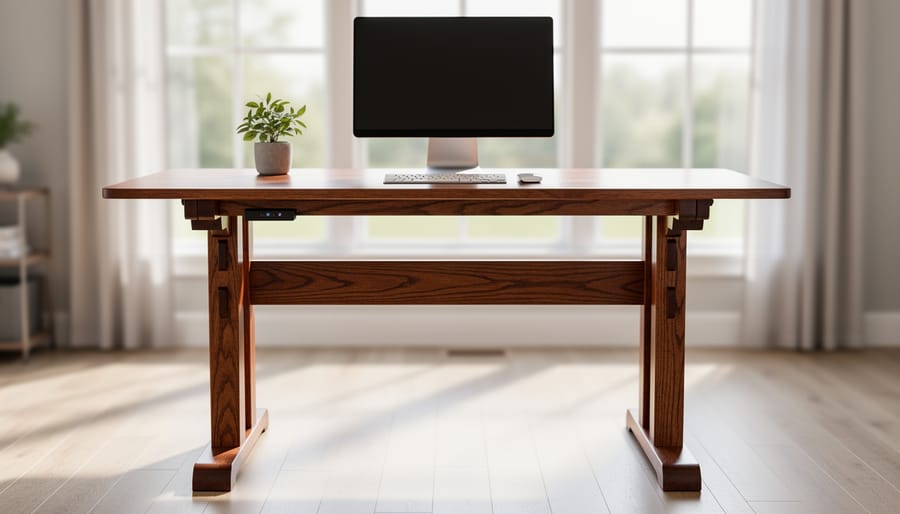
We tested the DutchCrafters Amish Standing Desk expecting a compromise between traditional craftsmanship and modern ergonomics, but found it delivers both without sacrificing either. Where most standing desks rely on engineered wood surfaces and industrial design, this desk brings the longevity of solid hardwood construction to the adjustable-height category.
The most striking difference is the wood itself. Our test unit featured solid oak throughout, with visible grain patterns and hand-applied finish that you won’t find on particleboard or MDF surfaces. We examined the joinery closely and found mortise-and-tenon construction where mass-market desks use screws and brackets. This matters for long-term durability: after weeks of daily height adjustments, the joints showed no loosening or stress marks that typically appear in engineered furniture.
Height adjustment uses a manual crank mechanism rather than electric motors. We clocked the transition from sitting to standing at about 15 seconds, slower than the Uplift V3’s motorized system, but the trade-off brings mechanical simplicity with fewer failure points. The crank handle tucks beneath the desktop when not in use, maintaining the clean lines of traditional furniture. During testing, we never experienced the slight wobble that plagues some electric standing desks at full extension. The solid wood frame and substantial corner bracing created a rock-steady surface even at maximum height.
The desk accommodates various wood species through DutchCrafters’ customization options. We saw examples in cherry, walnut, and maple during our evaluation, each with different grain characteristics and color depth. This flexibility lets you match existing furniture or choose wood that fits your workspace aesthetic, something engineered surfaces can’t replicate convincingly.
For woodworkers and DIY furniture makers, this desk demonstrates how traditional joinery techniques adapt to modern ergonomic needs. The construction methods mirror what you’d use in a shop project, making it both an investment piece and a reference example for anyone considering building their own standing desk.
How We Tested Wooden Desks
We evaluated wooden desks through rigorous hands-on testing designed to reveal how they perform in daily home office use. Our testing process drew on our team’s woodworking expertise and understanding of furniture construction, allowing us to assess not just surface-level features but the underlying quality that determines long-term durability.
Each desk underwent a systematic evaluation process:
- Initial assembly and construction assessment: We assembled each desk from start to finish, timing the process and noting instruction clarity, hardware quality, and whether pre-drilled holes aligned properly. This revealed manufacturing precision and how well the desk would hold up to repeated disassembly if needed.
- Wood quality and joinery inspection: We examined grain patterns, finish consistency, and edge treatment across all wood surfaces. For solid wood desks, we checked joint construction, dovetails, mortise-and-tenon, or dowel joints, to verify authentic woodworking techniques versus simple butt joints with screws.
- Stability testing across height ranges: For standing desks, we tested wobble at minimum, maximum, and three intermediate heights using a consistent 30-pound lateral force applied to the desktop edge. We measured horizontal movement with a dial indicator to quantify stability differences.
- Surface durability and finish testing: We subjected desktop surfaces to common home office hazards including water rings from coffee mugs, accidental pen marks, laptop heat exposure, and minor impact from dropped objects. We photographed results after 24 hours to document finish resistance.
- Ergonomic positioning evaluation: We measured actual usable workspace dimensions, tested keyboard tray functionality where present, and verified whether the height range genuinely accommodated users from 5’2″ to 6’4″ based on proper ergonomic positioning guidelines.
- Long-term use observation: Team members worked at each desk for a minimum of two weeks, documenting any developing issues like finish wear patterns, loosening hardware, or stability changes over time with repeated height adjustments.
We weighted stability and wood quality most heavily in our rankings because these factors determine whether a desk remains functional after years of use. Our testing revealed significant differences in construction quality even among desks at similar price points, particularly in how wood surfaces held up to daily wear and whether joints remained tight after assembly.
Choosing the Best Wood for Your Home Office Desk
When you’re choosing a wooden desk, the type of wood determines everything from how long your desk will last to how much maintenance it’ll need. We found during testing that understanding these differences helps you match the desk to your actual needs rather than just picking the prettiest finish.
Hardwoods: The Premium Choice
Oak, maple, walnut, and cherry dominate the quality desk market for good reason. These hardwoods resist dents and scratches far better than alternatives, which matters when you’re setting down coffee mugs, stacking books, or working on projects day after day. Oak offers distinctive grain patterns and exceptional durability, making it a favorite for traditional executive desks and the handcrafted pieces we saw from DutchCrafters. Maple provides a smoother, more uniform surface that takes stain beautifully and holds up to heavy use. Walnut brings rich, dark tones with elegant grain that needs minimal finishing to look stunning. Cherry develops a deeper patina over time, meaning your desk actually gets better looking with age.
The tradeoff is cost. Hardwood desks command higher prices because the materials are denser, harder to work with, and take longer to season properly. If you’re considering building your own desk, expect to pay significantly more for hardwood lumber, but you’ll end up with furniture that can last generations instead of years.
Softwoods and Budget Options
Pine and other softwoods cost less and work more easily, which explains their popularity in DIY projects and budget desks. They’re lighter weight, making assembly easier, and they accept paint and stain readily. The downside shows up in everyday use: softwoods dent more easily, scratches accumulate faster, and the surface may not hold up to decades of work the way hardwoods do. For a first build or temporary setup, softwoods make sense. For a desk you plan to use daily for years, the durability gap becomes noticeable.
Engineered Wood Surfaces
Many modern desks, including some of the standing desk models we tested, use engineered wood surfaces rather than solid hardwood. These surfaces combine wood particles or veneers with adhesives to create stable, affordable desktop materials. Medium-density fiberboard (MDF) with a wood veneer facing provides smooth surfaces at lower costs. Plywood cores with hardwood veneers offer better strength while still reducing material costs.
- Solid Wood
- Lumber cut directly from a tree and used without lamination or particle bonding. Offers maximum durability and can be refinished multiple times over its lifespan.
- Engineered Wood
- Man-made wood products created by binding wood particles, fibers, or veneers together with adhesives. Includes plywood, MDF, and particleboard, offering cost savings and dimensional stability.
- Hardwood vs Softwood
- Hardwoods come from deciduous trees (oak, maple, walnut) and are denser and more durable. Softwoods come from coniferous trees (pine, cedar) and are lighter and easier to work but less scratch-resistant.
- Wood Grain
- The visible pattern created by growth rings and fiber orientation in wood. Affects appearance, strength direction, and how the wood responds to staining and finishing.
- BIFMA Compliance
- Standards set by the Business and Institutional Furniture Manufacturers Association for furniture safety, durability, and structural adequacy. BIFMA-compliant desks meet rigorous testing for stability and load capacity.
Engineered surfaces have come a long way. Quality veneers look nearly identical to solid wood, and they resist warping better because the layered construction counteracts wood’s natural tendency to expand and contract with humidity changes. The limitation is refinishing, you can’t sand through a thin veneer the way you can resurface solid wood multiple times.
Grain, Finish, and Longevity
Wood grain affects both aesthetics and function. Open-grain woods like oak show prominent texture and character, while closed-grain species like maple present smoother surfaces. Your finish choice protects the wood: polyurethane creates durable, water-resistant surfaces; oil finishes penetrate the wood for a natural look but require more maintenance; lacquer provides a hard, clear coating that’s popular on professional furniture.
We’ve seen too many people choose based solely on appearance, then regret it when maintenance becomes a chore. Oil-finished walnut looks incredible but needs reapplication every few years. Polyurethane-coated oak handles spills and scratches with minimal care. Match the finish to how you actually work.
For DIY builders, your wood choice directly impacts your budget, tool requirements, and skill demands. Hardwoods require sharp blades, more sanding, and careful joinery, but they reward you with heirloom-quality results. Softwoods forgive beginner mistakes and work faster. Either way, understanding these fundamentals helps you build something that’ll serve you well instead of something you’ll need to replace in a few years.
Key Features to Consider When Buying a Wooden Desk
When you’re shopping for a wooden desk, the right features make the difference between a workspace that supports your productivity and one that leaves you frustrated. Start by measuring your workspace and identifying what you’ll actually do at the desk each day. If you’re juggling multiple monitors, a keyboard, sketches, and project materials, you’ll need more surface area than someone who works primarily on a laptop. We found during our testing that cramped workspace is one of the quickest routes to clutter and inefficiency.
Storage matters more than most people realize upfront. Built-in drawers, file cabinets, and shelving keep your workspace clear and reduce the need for separate furniture. Consider whether you need lockable storage for sensitive documents, shallow drawers for office supplies, or deep file drawers for project folders. Roll top desks and secretary desks excel here by hiding clutter completely when you’re done working.
Ergonomics directly affect your comfort during long work sessions. The standard desk height of 29 to 30 inches works for many people, but if you’re taller or shorter than average, you’ll benefit from adjustable height options. Standing desks like the Uplift V3, with its 22.6 to 48.7-inch range, accommodate over 95% of users and let you alternate between sitting and standing throughout the day. Pay attention to keyboard position too, your elbows should rest at roughly 90 degrees when typing, and your monitor should sit at eye level to prevent neck strain.
Stability becomes critical when you’re typing, writing, or working with precision tools. Look for BIFMA compliance and weight capacity ratings that exceed what you’ll actually place on the desk. During our tests, we pushed, leaned, and typed vigorously on each desk to assess real-world stability, and the difference between a solid build and a shaky one was immediately obvious.
Assembly requirements vary widely. Some solid wood desks arrive fully assembled or need minimal setup, while others, particularly larger L-shaped or executive models, require significant time and effort. Check reviews for assembly feedback and make sure you have the tools and help you’ll need. Finally, customization options let you tailor the desk to your exact needs. Many manufacturers, including DutchCrafters with their solid wood Amish desks, offer choices in wood species, finish color, hardware, and configuration that make the desk uniquely yours.
Wooden Desk Styles for Different Home Office Needs
Wooden desks come in distinct configurations, each designed to support different work styles and spatial layouts. Understanding these categories helps match your desk choice to how you actually use your workspace.
Computer desks remain the most common style, designed specifically for keyboard work and monitor placement. These typically feature a compact footprint with an integrated keyboard tray or lower shelf, making them ideal for small home offices where every square foot counts. We’ve found they work best when you’re primarily focused on digital tasks without extensive paperwork or project materials.
L-shaped and corner desks maximize workspace by utilizing room corners that often go unused. The perpendicular surfaces create distinct zones for different activities, one side for computer work, the other for writing, spreading out documents, or woodworking project planning. This configuration suits professionals who juggle multiple tasks simultaneously and need room to keep materials visible and accessible. DutchCrafters offers solid wood versions in both L-shaped and dedicated corner configurations.
Executive and pedestal desks bring a formal aesthetic with substantial surface area and built-in storage drawers flanking the knee space. The symmetrical drawer pedestals provide ample file and supply organization without requiring separate cabinets. These desks anchor a professional home office where client video calls and polished presentation matter.
Roll top and secretary desks feature a retractable or fold-down cover that conceals workspace clutter when you’re not working. The roll top design works beautifully in shared living spaces where the office needs to disappear at day’s end. Secretary desks fold up vertically, making them exceptionally space-efficient for apartment dwellers.
Standing desks with wooden surfaces combine ergonomic height adjustment with natural materials. Credenza desks function as low, long storage units with workspace on top, often used alongside a primary desk for additional surface area and organization.
Frequently Asked Questions
What’s the most durable wood for a desk?
Hardwoods like oak, maple, and walnut offer the best durability for desk surfaces because of their density and resistance to dents and scratches. These species can handle daily wear from keyboards, monitors, and other office equipment for decades when properly finished.
How do I maintain a wooden desk surface?
Wipe your desk with a soft, slightly damp cloth weekly to remove dust, and avoid placing hot items directly on the surface. Use coasters under drinks, and apply a furniture polish or wax every few months to protect the finish and keep the wood looking fresh.
Are wooden standing desks stable enough for daily use?
Quality wooden standing desks like the Uplift V3, which accommodates over 95% of users with exceptional stability across its 22.6 to 48.7-inch height range, are absolutely stable enough for daily use. The key is choosing a desk with a solid frame design and proper weight distribution rather than relying on the wood surface alone for stability.
What’s the difference between solid wood and wood veneer?
Solid wood desks are milled from single planks or joined boards of real hardwood throughout, offering superior durability and the ability to refinish multiple times. Veneer consists of a thin layer of real wood glued over engineered wood or particleboard, which looks similar initially but can’t be sanded down and refinished as many times.
When you’re deciding between these construction methods, consider your long-term plans. Solid wood costs more upfront but becomes an heirloom piece that ages beautifully and can survive moves, refinishing, and even minor repairs. We’ve seen solid wood desks from makers like DutchCrafters that clients plan to pass down to their kids. Veneer works well if you’re looking for the aesthetic of real wood on a tighter budget and don’t anticipate needing to refinish the surface.
Assembly difficulty varies widely depending on the desk style and manufacturer. Traditional fixed desks with pedestal storage typically require attaching legs, drawer slides, and possibly a hutch, which takes one to two hours with basic tools. Standing desks involve more steps since you’re mounting the motor assembly, control panel, and desktop, but most come with clear instructions and pre-drilled holes. DutchCrafters’ solid wood Amish desks often arrive mostly assembled due to their traditional joinery, requiring mainly the attachment of larger components. If you’ve built any furniture before or followed woodworking tutorials, you’ll handle most desk assembly without trouble.
After testing and evaluating seven wooden desks, the Uplift V3 Standing Desk stands out as the best choice for most home office setups. Its BIFMA-compliant height range and exceptional stability make it a reliable workhorse that accommodates virtually anyone, while the wood surface options let you match your workspace aesthetic. Whether you’re working through back-to-back video calls or tackling detailed woodworking plans, you need a desk that won’t wobble or distract.
The right wooden desk represents a genuine investment in your daily productivity and workspace environment. Quality wood construction delivers durability that outlasts particle board alternatives, ages gracefully with proper care, and provides the substantial feel that keeps you focused during long work sessions. We’ve seen how solid wood desks from sources like DutchCrafters can serve multiple generations when built with proper joinery and finished correctly.
Consider your specific needs before buying. Do you spend eight hours at the keyboard, or do you sketch designs and spread out project materials? Will you benefit from the ergonomic advantages of a standing desk, or does your workflow demand the expansive surface of an L-shaped configuration? If you’ve got the woodworking skills and enjoy hands-on projects, building your own custom desk lets you control every dimension, wood species, and finish detail to create exactly what your workspace requires.
The desk you choose shapes how you work every single day. Invest the time to find the right fit.
